
For most people in the Summit County area, Lock 3 Park is the default destination on the Fourth - and this year, it comes with a three-day food festival wrapped around it.
The All-American Burger & BBQ Festival runs from July 2-4, 11 a.m. to 11 p.m. each day. The vendor lineup includes After Hours BBQ, PigFoot BBQ, Stray Dog, Big Blue BBQ, Da Dawg House, Metro 45, Come Get Fried, Lady T's, and more. The city's DORA (designated outdoor refreshment area) is in effect, so yes - you can walk around with your drink.
The fireworks themselves go at 9:45 p.m. on Saturday, July 4. No tickets, no cost. Just get there early - the good spots along Main Street and Lock 3's backyard on Bowery fill up well before the show.
Practical tip: If you're driving from Mogadore or Tallmadge, aim to arrive by 7:30 p.m. or earlier. Parking downtown fills fast on the Fourth. The lot on Canal Street and the one off Exchange are your best bets, but a lot of locals just park on the outer edges and walk in.
Canal Park: the RubberDucks go full America
Akron RubberDucks at Canal Park are doing fireworks after every game July 3, 4, and 5.
The details:
Date
Game time
Opponent
Special event
Friday, July 3
7:17 p.m.
Erie SeaWolves
Military Appreciation Night + fireworks
Saturday, July 4
7:05 p.m.
Erie SeaWolves
Independence Day fireworks + LED Rally Towel giveaway
Sunday, July 5
6:35 p.m.
Erie SeaWolves
Kids Run the Bases + fireworks
The July 4 game sold out - so if you haven't grabbed tickets, check the July 3 and July 5 games, which still have availability. Tickets for the "Fourth on the Field" event start at $5, with gates opening at 7:00 p.m. on Independence Day.
Canal Park sits at 300 S. Main St., Akron - close enough to downtown that the Lock 3 fireworks at 9:45 p.m. are visible from outside the stadium if your game runs late.
Blossom Music Center: the Cleveland Orchestra does the Fourth right
If you want to mark America's 250th with something genuinely memorable, Blossom Music Center is worth the trip.
The Cleveland Orchestra is doing two separate events:
America at 250 - Friday, July 3 at 8 p.m. American orchestral works performed by the full Cleveland Orchestra, with fireworks at the end. Blossom is at 1145 W. Steels Corners Rd., Cuyahoga Falls - about 20 minutes from Mogadore.
Salute to America - Saturday, July 4 at 8 p.m. The annual patriotic concert with the Blossom Festival Band, patriotic tunes, and fireworks. This one's the more traditional of the two - think Sousa marches and familiar American anthems under the pavilion, then a fireworks finale over the lawn.
Both require tickets. The lawn is more affordable than the covered pavilion and frankly a great experience in good weather.
Around Summit County: events closer to home
Not everyone wants to fight downtown traffic. Here's what's happening in the communities closer to home for Great Move Realty's neighborhoods:
Summit County 4th of July events map for 2026, as taken from Northeast Ohio Family Fun
Green: FreedomFest (June 27)
The City of Green is jumping the gun on the holiday in the best way. Their FreedomFest at Boettler Park runs June 27 from noon to 11 p.m. - games, food vendors, live music, and fireworks to kick off the holiday season. This is the event for families with young kids who want a calmer experience away from the downtown crowds.
Hudson: lighting our legacy festival (July 3)
Barlow Farm Park in Hudson is doing a full evening on July 3 - gates open at 6 p.m., Journey tribute band E5C4P3 takes the stage at 7:30 p.m., and fireworks at dusk. The park is at 1965 Barlow Rd., Hudson - a clean, family-friendly experience in one of Summit County's nicest green spaces. Rain date is July 5.
Stow: 4th of July Parade (July 4)
Stow's parade runs July 4 starting at 10 a.m. The route starts at Kent Road (Target Plaza parking lot) and ends west of Holy Family Church. It's Stow's 68th parade - a solid neighborhood tradition for families in eastern Summit County. If you want to get moving before the heat of the day, the city's Firecracker Run kicks off at 7:30 a.m. the same morning.
Cuyahoga Falls: America 250 Celebration (July 3)
The Downtown Plaza in Cuyahoga Falls is hosting a July 3 event from 6 to 10 p.m. with the Buck Naked Band playing live starting at 7 p.m., local craft beer, food trucks, and fireworks at 10 p.m. It's a walkable, relaxed alternative to downtown Akron, and the July 3 timing means you can do both nights if you're ambitious.
Portage Lakes: the big show on July 11
Worth marking on the calendar even though it's a week later: the annual Portage Lakes fireworks goes off on July 11 at 10 p.m. from Portage Lakes State Park. The Portage Lakes Fireworks Association runs what's widely known as the largest privately funded fireworks show in Ohio. The Portage Lakes Boat Parade runs at 1 p.m. the same day, and there's a Sandcastle Building Contest at 1:30 p.m. This is a full day on the water - one of the best summer traditions in Summit County.
What makes this 4th different: America 250
This isn't just any Fourth of July. 2026 marks the 250th anniversary of American independence, and communities across Northeast Ohio are leaning into it. The Akron Bicentennial Festival is centered at Lock 3, Cuyahoga Falls is billing its event "America 250 Celebration," and the Cleveland Orchestra's concert series is explicitly tied to the sesquicentennial milestone.
It's also worth knowing a bit of local history: John Brown, the abolitionist, rented and lived in a home at 514 Diagonal Road in Akron from 1844 to 1854, under a lease from Col. Simon Perkins. The home is listed on the National Park Service's Underground Railroad Network to Freedom. Akron's history runs deeper than most people realize.
Fireworks at home? Here's what Ohio law actually says
A lot of people in Mogadore, Hartville, and Uniontown want to do their own backyard shows. The rules are more specific than you'd think:
Ohio fireworks rules for July 4th - what's allowed and what's not, as taken from Akron Beacon Journal
When: 4–11 p.m. on July 3, 4, and 5 (and the Friday, Saturday, and Sunday immediately before and after the holiday)
Where: Your own property, or another person's property with their permission
What: Only 1.4G consumer fireworks purchased from a licensed Ohio store - these are standard consumer-grade fireworks, not professional shells
Off-limits: Public property, schools, indoors, drought/red flag conditions, within 150 feet of a property with livestock (unless you've given written notice five days in advance)
Minors: Not allowed to set off fireworks
Alcohol/drugs: A first-degree misdemeanor to discharge fireworks while impaired
One important caveat: local governments can add restrictions or ban fireworks entirely. Check with your township before you set anything up - Mogadore, Tallmadge, and Hartville all have their own local ordinances that may limit what's allowed.
Quick tips for enjoying the shows
Akron July 4th viewing guide - arrival tips, parking, and what to bring
A few things worth knowing before you head out:
Arrive early. Lock 3 is free and open, which means there's no line to manage - just limited good standing and sitting spots. The BBQ festival creates crowds from mid-afternoon on. If you want a prime spot for the 9:45 p.m. fireworks, aim to be in place by 8 p.m. at the latest.
Parking strategy for downtown. The parking lots on Canal St. and around the FirstEnergy building fill early. Locals often park closer to the University of Akron or on the neighborhoods' edge streets and walk in. It's usually a 10-15 minute walk from the outer lots, and you'll avoid the post-show gridlock.
Think about your pets. The fireworks season from late June through July 4 is genuinely hard on dogs and cats. If you have pets at home, the AKC has solid advice on reducing anxiety. Plan to leave them somewhere comfortable before the evening starts.
Weather on July 4.AccuWeather's early forecast for Akron on July 4 shows 86 degrees and sunny - perfect fireworks weather. That said, it's still early, so keep an eye on forecasts as the day gets closer.
Great Move Realty
Northeast Ohio's 4th of July events are a reminder of what makes communities like Mogadore, Tallmadge, Hartville, Green, and Uniontown special places to live. If you're thinking about buying or selling a home in Summit County this summer, Great Move Realty knows these neighborhoods the way only a truly local brokerage can. Principal Broker Mike Love has spent 15+ years helping buyers and sellers navigate the NE Ohio market - with 259 transactions closed, certifications in pricing strategy, military relocation, and negotiation, and a straightforward approach built on education and transparency.
Not all HOAs are created equal. Here's how to spot a well-run condo association - and the red flags that should send you running.
June 22, 2026·10 min read
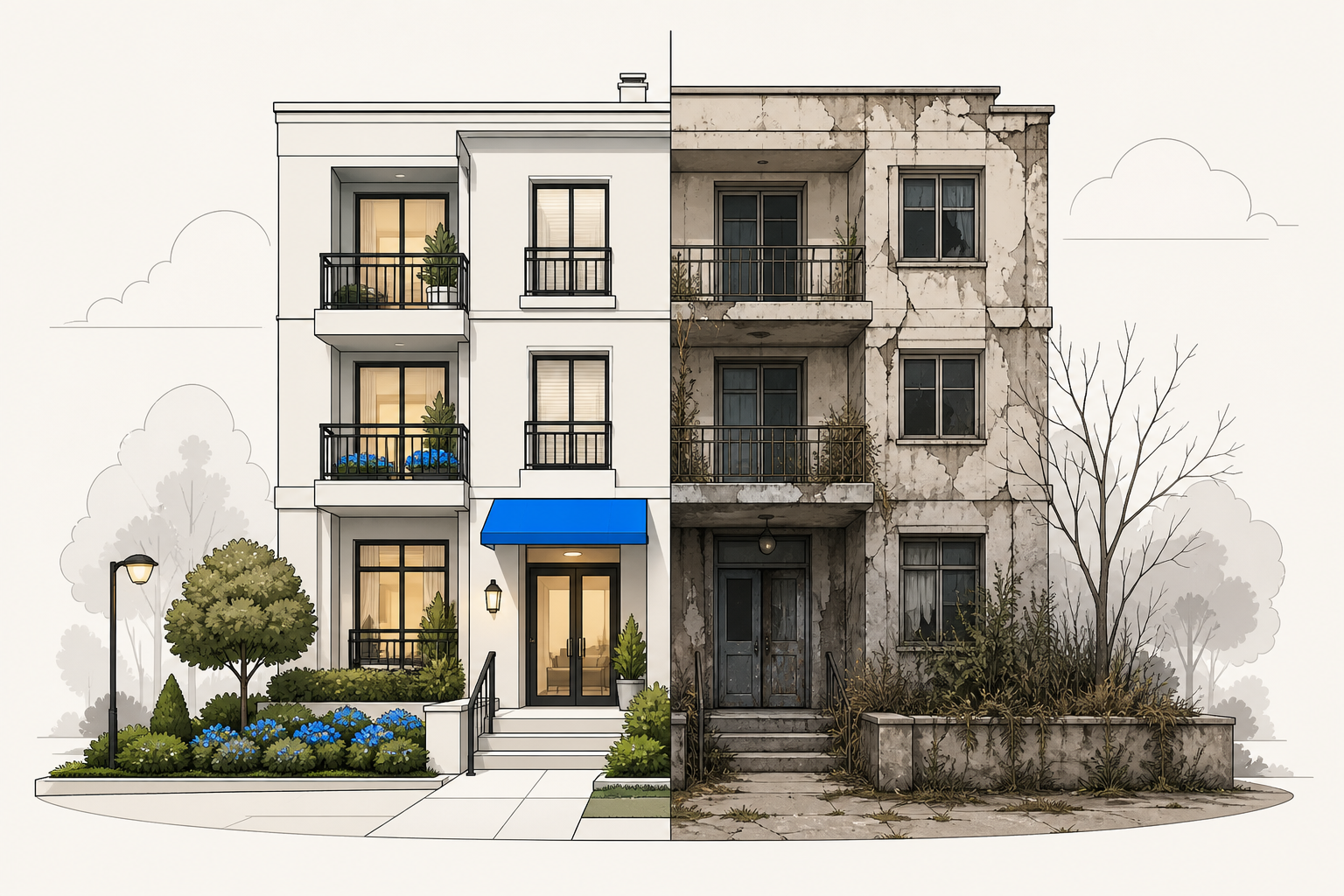
The HOA can make or break a condo purchase - and it won't be obvious from a tour of the unit. Here's what you actually need to look at:
The reserve fund is the single most important number. It should be 30-70% of the annual budget. 55% of HOAs fall short, which means surprise assessments of $2,000-$5,000 or more per unit.
Green flags: healthy reserves, transparent finances, professional management, active board elections, consistent rule enforcement.
Red flags: financial opacity, deferred maintenance, the same board members for years on end, selective enforcement, and unexplained special assessments.
Request these before you make an offer: the reserve study, three years of financials, 12 months of board minutes, and the special assessment history.
Why the HOA matters
You found a condo with great light, updated kitchen, and a price that works. The unit itself checks every box. But before you write an offer, there's one more thing worth knowing: you're not just buying the unit. You're buying into the association that runs everything around it.
Roughly 85-90% of condominiums in the United States are governed by a homeowners association - an elected board responsible for maintaining shared spaces, collecting dues, and making big decisions about the building's future. In northeast Ohio, most condo HOAs charge between $250 and $400 a month in dues. That's real money, and what you get for it depends almost entirely on how well the association is run.
A great HOA means responsive management, a clean and well-maintained community, and - most importantly - a financial cushion that absorbs the big expenses without passing them directly to you. A troubled HOA means deferred maintenance creeping across the building, a reserve fund that's basically a rounding error, and the eventual knock on your door asking for $10,000 to fix the roof.
The challenge is that none of this is visible from a one-hour showing. You need to look at the documents.
Green flags: signs of a well-run HOA
Healthy reserves (30-70% of annual budget)
This is the number. If there's only one piece of financial data you look at, make it this one.
Reserves are the HOA's savings account for future capital expenses - roof replacement, parking lot resurfacing, elevator repairs, pool pump replacement. A reserve study (which any legitimate HOA should have) projects these costs decades out and tells you whether the current savings level is adequate.
The Community Associations Institute recommends reserves sit between 30-70% of the annual operating budget. HOAs with adequate reserves face 25% fewer special assessments. The ones with strong reserves aren't special - they just had a board that planned ahead and enforced disciplined savings over time.
Ask for the reserve study. Read the full document, not the board's summary of it.
Transparent, well-reported finances
A well-run HOA treats its finances like a business. That means annual financial statements available to all residents, regular reporting (monthly or quarterly, not just annually), and fee increases that are clearly explained and gradual - under 10% annually is the norm; anything over 15% in a year deserves a conversation.
Good associations make it easy to understand what your dues cover. Bad ones make you feel like you're trying to read a foreign language.
Professional property management
There's a meaningful difference between a professional property management company and a volunteer board running the show. Professional management means a dedicated staff handling maintenance requests (typically with 48-hour response times), clear communication channels, and institutional knowledge that doesn't walk out the door when a board member moves away.
"The difference between our place and a friend's condo? Professional property management company vs. volunteer board. Our HOA runs like a business. His HOA runs like a committee. Guess which community is deteriorating?" - r/realestate
Ask who manages the property, how long they've been in the role, and how maintenance requests are handled. Frequent management company turnover is itself a red flag.
Active board elections and engaged ownership
A healthy HOA has fresh faces running for the board regularly - multiple candidates, annual elections, and a culture where homeowners actually show up. Low meeting attendance and uncontested elections year after year are signs of apathy or dysfunction, both of which tend to compound over time.
One particularly useful metric: owner-occupancy percentage. Owner-occupied buildings have 40% higher meeting participation and 35% fewer maintenance issues than those with high investor ownership. If a building is 60% rentals, the people making decisions have different priorities than the people living there.
Aim for 75% or higher owner-occupancy. Ask directly - it's a question any listing agent should be able to answer.
Fair, consistent rule enforcement
Nobody loves HOA rules. But there's a real difference between rules that are enforced consistently and rules that seem to apply to some residents and not others. Well-run associations issue warnings before fines, have a documented appeals process, and hold all residents - including board members - to the same standard.
When you review the CC&Rs, check whether the rules are reasonable and clearly written. Overly vague rules are harder to enforce consistently and create more room for disputes.
Red flags: signs of a troubled HOA
Underfunded reserves
We said this already, but it bears repeating: 55% of HOAs in the United States have inadequate reserves, with the national average sitting around 24% - well below the recommended floor of 30%. HOAs with reserves below 10% face six times the risk of special assessments compared to well-funded ones.
The consequences are predictable. Boards that can't afford to fix things don't fix them. When they absolutely have to, they levy a special assessment. Those assessments typically run $2,000 to $5,000 per unit for routine capital work - and can hit $10,000-$25,000 when something major has been ignored for years.
"Our HOA claimed we had adequate reserves. During the sale process, I asked for the reserve study and it showed we needed $2.3M in repairs but only had $200k saved up. That's when I learned the board had been lying about our financial situation for years." - r/realestate
Don't trust the board's summary. Get the actual reserve study and calculate the percentage yourself.
Financial opacity
If a board is reluctant to share financial statements - or can only produce documents that are vague and hard to follow - take that as a warning. Transparent HOAs have nothing to hide. When a board says "we don't share that with prospective buyers," walk away.
The same goes for fee history. If dues went from $180 to $280 over five years without a clear explanation tied to capital improvements or rising costs, something wasn't being planned for. A pattern of unexplained increases often signals a board papering over financial problems rather than solving them.
Deferred maintenance you can see
Take a walk before you make an offer. Not just through the unit - through the parking lot, the hallways, the lobby, the landscaping, the pool area. What you see tells you a lot about what the board's priorities have been.
Cracked pavement, peeling paint, aging roofs, broken fixtures that have been "temporarily" closed for months - these aren't just aesthetic problems. They're evidence of a board that either can't afford maintenance or doesn't prioritize it. Either way, those problems don't fix themselves.
"Nobody told me to look at the parking lot when I toured the unit. I was focused on the kitchen. Now I'm watching it crumble and the board says we don't have money for repairs." - r/homeowners
Ask specifically when major systems were last replaced: roof, HVAC, parking lot, elevators. If the answers are vague or the board doesn't know, that's telling.
Stagnant board with no fresh voices
A board where the same two or three people have been running things for ten-plus years, with little challenge from the community, is a board without accountability. It's also often a sign that the community has given up on participation - which usually means things have been going wrong long enough that people have checked out.
Board longevity isn't automatically bad. But board longevity without community engagement, transparent communication, and documented results is a red flag.
Selective or aggressive enforcement
You should be able to read the rules and understand them. And those rules should apply the same way to everyone - not more strictly to units the board doesn't like and more loosely to the board's friends.
If residents report inconsistent fines, a lack of warnings before penalties, or an enforcement culture that feels punitive rather than fair, that environment tends to persist. HOA disputes are both exhausting and expensive.
"We got a fine for 'excessive garden furniture' when we literally just had two patio chairs. No warning. Other residents have furniture everywhere with no fines. The enforcement is completely random." - r/condo
Legal issues or pending litigation
Ask whether the HOA has any active lawsuits - against it, or filed by it against contractors or residents. Check whether there are any outstanding code violations from the city or county. Look for liens against the association for unpaid debts.
None of these automatically end a purchase, but all of them warrant a conversation with a real estate attorney before you close.
The documents to request before you buy
Here's the short list. Any legitimate HOA should be able to provide all of these, and most states require sellers to disclose them anyway:
Document
Why it matters
Reserve study (most recent, ideally within 3 years)
Shows projected capital needs and current funding percentage
3 years of financial statements
Reveals fee trends, actual vs. budgeted expenses, and any pattern of assessments
12 months of board meeting minutes
Shows what issues the board is dealing with - and how they're handling them
CC&Rs and rules
Tells you what you can and can't do, and how enforcement works
Special assessment history (last 5 years)
Shows whether surprise charges have been common and why
Management contract
Confirms who manages the property and what their scope includes
Don't rely on a summary from the seller's agent. Request the actual documents and read them - or have someone who knows what to look for read them with you.
5 questions every condo buyer should ask
Most buyers don't ask these. The ones who do tend to avoid the biggest surprises.
1. Has there been a special assessment in the last five years? Is another one planned?
This is the question people most commonly skip. A "yes" isn't automatically a dealbreaker, but you need to know what it was for and whether the underlying problem was actually solved or just patched.
2. What percentage of units are owner-occupied versus investor-owned?
High investor ownership (above 25-30%) is a signal worth investigating. It often corresponds to lower board meeting participation, more deferred maintenance, and a community where decisions are made by people who don't live there.
3. What is the current reserve funding percentage?
Calculate it yourself: divide the current reserve balance by the annual operating budget. Anything below 30% warrants serious scrutiny. Anything below 10% is a significant financial risk.
4. How are maintenance requests handled, and what's the typical response time?
A good management company responds within 48 hours. Volunteer boards often can't match that - not because they don't care, but because they have jobs and lives. If the property is self-managed by volunteers, understand what that means for responsiveness and institutional knowledge.
5. When were the roof, parking lot, and major mechanical systems last replaced?
If the roof is 20 years old and the reserve fund is underfunded, you can do the math. Ask specifically - vague answers are themselves informative.
The HOA due diligence checklist
Print this out or screenshot it before your next condo showing.
Financial (start here)
[ ] Request the reserve study - read the full document, not just the summary
[ ] Track the fee trend - gradual increases are fine, sudden spikes warrant a conversation
Governance
[ ] Request 12 months of board meeting minutes
[ ] Find out how long current board members have served
[ ] Ask whether management is professional or volunteer-run
[ ] Attend an open board meeting if possible
Physical condition
[ ] Walk the entire community - don't just tour the unit
[ ] Check condition of parking, exterior, hallways, landscaping
[ ] Ask when roof, HVAC, elevators, and parking were last replaced or repaired
[ ] Note any amenities that are closed or "temporarily unavailable"
Community health
[ ] Ask the owner-occupancy percentage (aim for 75%+)
[ ] Ask about unit turnover - low turnover signals a community people want to stay in
[ ] Check for active litigation or outstanding city/county code violations
A condo in a well-run HOA community appreciates faster - research suggests 10-15% faster than comparable units in communities with deferred maintenance and underfunded reserves.
Akron's surrounding suburbs offer some of the best entry-level home values in Ohio. Tallmadge is the closest and most budget-friendly, Mogadore and Hartville offer small-town character, Springfield Township sits next to a nearly 1,000-acre metro park, and Ellet puts you inside the city limits at prices that still make sense for a first-timer. Read on for the full breakdown
Buying your first home is one of the biggest financial decisions you'll ever make - and picking the right neighborhood might matter even more than picking the right house. A great house in the wrong area can leave you with a long commute, underw...
When people ask what it's like to live in Mogadore, the answer changes with the season. In summer, it becomes one of the most compelling cases for small-town Ohio living. Within a 20-minute drive of this quiet village in Portage County, you have a 27-mile reservoir shoreline, a national park with a 60-foot waterfall, a state park built for jet skis and sailboats, and a summer festival that fills Lions Park with food trucks and live music every July.
This guide covers everything worth doing within the Mogadore area this summer - from the outdoor activities that are literally on your doorstep to the day trips that make every weekend feel like a vacation.
Mogadore Reservoir: For Mogadore residents, the reservoir isn't just nearby - it's part of daily life. The Mogadore Reservoir spans 1,104 acres with 27 miles of shoreline, and it's remarkably uncrowded for a body of water this size. Only electric motors ar...
We respect your concerns about privacy and value the relationship that we have with you.
Like many sites, we use cookies on our website to collect information to help improve your browsing experience. The cookies that we use allow our website to work and help us to understand what information is most useful to visitors.