
Not all HOAs are created equal. Here's how to spot a well-run condo association - and the red flags that should send you running.
June 22, 2026·10 min read
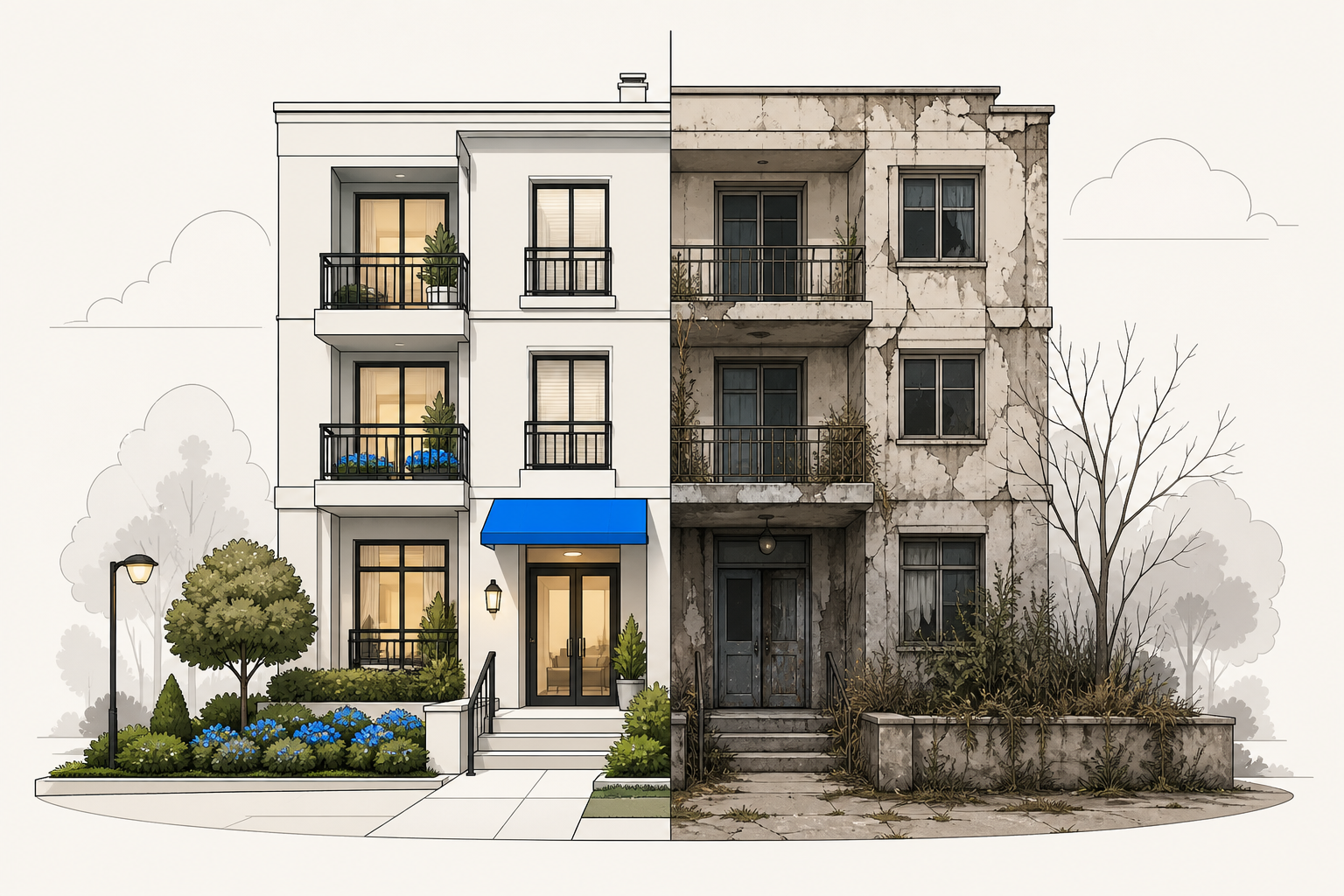
The HOA can make or break a condo purchase - and it won't be obvious from a tour of the unit. Here's what you actually need to look at:
The reserve fund is the single most important number. It should be 30-70% of the annual budget. 55% of HOAs fall short, which means surprise assessments of $2,000-$5,000 or more per unit.
Green flags: healthy reserves, transparent finances, professional management, active board elections, consistent rule enforcement.
Red flags: financial opacity, deferred maintenance, the same board members for years on end, selective enforcement, and unexplained special assessments.
Request these before you make an offer: the reserve study, three years of financials, 12 months of board minutes, and the special assessment history.
You found a condo with great light, updated kitchen, and a price that works. The unit itself checks every box. But before you write an offer, there's one more thing worth knowing: you're not just buying the unit. You're buying into the association that runs everything around it.
Roughly 85-90% of condominiums in the United States are governed by a homeowners association - an elected board responsible for maintaining shared spaces, collecting dues, and making big decisions about the building's future. In northeast Ohio, most condo HOAs charge between $250 and $400 a month in dues. That's real money, and what you get for it depends almost entirely on how well the association is run.
A great HOA means responsive management, a clean and well-maintained community, and - most importantly - a financial cushion that absorbs the big expenses without passing them directly to you. A troubled HOA means deferred maintenance creeping across the building, a reserve fund that's basically a rounding error, and the eventual knock on your door asking for $10,000 to fix the roof.
The challenge is that none of this is visible from a one-hour showing. You need to look at the documents.

This is the number. If there's only one piece of financial data you look at, make it this one.
Reserves are the HOA's savings account for future capital expenses - roof replacement, parking lot resurfacing, elevator repairs, pool pump replacement. A reserve study (which any legitimate HOA should have) projects these costs decades out and tells you whether the current savings level is adequate.
The Community Associations Institute recommends reserves sit between 30-70% of the annual operating budget. HOAs with adequate reserves face 25% fewer special assessments. The ones with strong reserves aren't special - they just had a board that planned ahead and enforced disciplined savings over time.
Ask for the reserve study. Read the full document, not the board's summary of it.
A well-run HOA treats its finances like a business. That means annual financial statements available to all residents, regular reporting (monthly or quarterly, not just annually), and fee increases that are clearly explained and gradual - under 10% annually is the norm; anything over 15% in a year deserves a conversation.
Good associations make it easy to understand what your dues cover. Bad ones make you feel like you're trying to read a foreign language.
There's a meaningful difference between a professional property management company and a volunteer board running the show. Professional management means a dedicated staff handling maintenance requests (typically with 48-hour response times), clear communication channels, and institutional knowledge that doesn't walk out the door when a board member moves away.
"The difference between our place and a friend's condo? Professional property management company vs. volunteer board. Our HOA runs like a business. His HOA runs like a committee. Guess which community is deteriorating?" - r/realestate
Ask who manages the property, how long they've been in the role, and how maintenance requests are handled. Frequent management company turnover is itself a red flag.
A healthy HOA has fresh faces running for the board regularly - multiple candidates, annual elections, and a culture where homeowners actually show up. Low meeting attendance and uncontested elections year after year are signs of apathy or dysfunction, both of which tend to compound over time.
One particularly useful metric: owner-occupancy percentage. Owner-occupied buildings have 40% higher meeting participation and 35% fewer maintenance issues than those with high investor ownership. If a building is 60% rentals, the people making decisions have different priorities than the people living there.
Aim for 75% or higher owner-occupancy. Ask directly - it's a question any listing agent should be able to answer.
Nobody loves HOA rules. But there's a real difference between rules that are enforced consistently and rules that seem to apply to some residents and not others. Well-run associations issue warnings before fines, have a documented appeals process, and hold all residents - including board members - to the same standard.
When you review the CC&Rs, check whether the rules are reasonable and clearly written. Overly vague rules are harder to enforce consistently and create more room for disputes.
We said this already, but it bears repeating: 55% of HOAs in the United States have inadequate reserves, with the national average sitting around 24% - well below the recommended floor of 30%. HOAs with reserves below 10% face six times the risk of special assessments compared to well-funded ones.
The consequences are predictable. Boards that can't afford to fix things don't fix them. When they absolutely have to, they levy a special assessment. Those assessments typically run $2,000 to $5,000 per unit for routine capital work - and can hit $10,000-$25,000 when something major has been ignored for years.
"Our HOA claimed we had adequate reserves. During the sale process, I asked for the reserve study and it showed we needed $2.3M in repairs but only had $200k saved up. That's when I learned the board had been lying about our financial situation for years." - r/realestate
Don't trust the board's summary. Get the actual reserve study and calculate the percentage yourself.

If a board is reluctant to share financial statements - or can only produce documents that are vague and hard to follow - take that as a warning. Transparent HOAs have nothing to hide. When a board says "we don't share that with prospective buyers," walk away.
The same goes for fee history. If dues went from $180 to $280 over five years without a clear explanation tied to capital improvements or rising costs, something wasn't being planned for. A pattern of unexplained increases often signals a board papering over financial problems rather than solving them.
Take a walk before you make an offer. Not just through the unit - through the parking lot, the hallways, the lobby, the landscaping, the pool area. What you see tells you a lot about what the board's priorities have been.
Cracked pavement, peeling paint, aging roofs, broken fixtures that have been "temporarily" closed for months - these aren't just aesthetic problems. They're evidence of a board that either can't afford maintenance or doesn't prioritize it. Either way, those problems don't fix themselves.
"Nobody told me to look at the parking lot when I toured the unit. I was focused on the kitchen. Now I'm watching it crumble and the board says we don't have money for repairs." - r/homeowners
Ask specifically when major systems were last replaced: roof, HVAC, parking lot, elevators. If the answers are vague or the board doesn't know, that's telling.
A board where the same two or three people have been running things for ten-plus years, with little challenge from the community, is a board without accountability. It's also often a sign that the community has given up on participation - which usually means things have been going wrong long enough that people have checked out.
Board longevity isn't automatically bad. But board longevity without community engagement, transparent communication, and documented results is a red flag.
You should be able to read the rules and understand them. And those rules should apply the same way to everyone - not more strictly to units the board doesn't like and more loosely to the board's friends.
If residents report inconsistent fines, a lack of warnings before penalties, or an enforcement culture that feels punitive rather than fair, that environment tends to persist. HOA disputes are both exhausting and expensive.
"We got a fine for 'excessive garden furniture' when we literally just had two patio chairs. No warning. Other residents have furniture everywhere with no fines. The enforcement is completely random." - r/condo
Ask whether the HOA has any active lawsuits - against it, or filed by it against contractors or residents. Check whether there are any outstanding code violations from the city or county. Look for liens against the association for unpaid debts.
None of these automatically end a purchase, but all of them warrant a conversation with a real estate attorney before you close.
Here's the short list. Any legitimate HOA should be able to provide all of these, and most states require sellers to disclose them anyway:
|
Document |
Why it matters |
|---|---|
|
Reserve study (most recent, ideally within 3 years) |
Shows projected capital needs and current funding percentage |
|
3 years of financial statements |
Reveals fee trends, actual vs. budgeted expenses, and any pattern of assessments |
|
12 months of board meeting minutes |
Shows what issues the board is dealing with - and how they're handling them |
|
CC&Rs and rules |
Tells you what you can and can't do, and how enforcement works |
|
Special assessment history (last 5 years) |
Shows whether surprise charges have been common and why |
|
Management contract |
Confirms who manages the property and what their scope includes |
Don't rely on a summary from the seller's agent. Request the actual documents and read them - or have someone who knows what to look for read them with you.
Most buyers don't ask these. The ones who do tend to avoid the biggest surprises.
1. Has there been a special assessment in the last five years? Is another one planned?
This is the question people most commonly skip. A "yes" isn't automatically a dealbreaker, but you need to know what it was for and whether the underlying problem was actually solved or just patched.
2. What percentage of units are owner-occupied versus investor-owned?
High investor ownership (above 25-30%) is a signal worth investigating. It often corresponds to lower board meeting participation, more deferred maintenance, and a community where decisions are made by people who don't live there.
3. What is the current reserve funding percentage?
Calculate it yourself: divide the current reserve balance by the annual operating budget. Anything below 30% warrants serious scrutiny. Anything below 10% is a significant financial risk.
4. How are maintenance requests handled, and what's the typical response time?
A good management company responds within 48 hours. Volunteer boards often can't match that - not because they don't care, but because they have jobs and lives. If the property is self-managed by volunteers, understand what that means for responsiveness and institutional knowledge.
5. When were the roof, parking lot, and major mechanical systems last replaced?
If the roof is 20 years old and the reserve fund is underfunded, you can do the math. Ask specifically - vague answers are themselves informative.

Print this out or screenshot it before your next condo showing.
Financial (start here)
[ ] Request the reserve study - read the full document, not just the summary
[ ] Confirm reserve funding percentage (reserves / annual budget) is 30%+
[ ] Review 3 years of financial statements
[ ] Ask for 5-year special assessment history
[ ] Track the fee trend - gradual increases are fine, sudden spikes warrant a conversation
Governance
[ ] Request 12 months of board meeting minutes
[ ] Find out how long current board members have served
[ ] Ask whether management is professional or volunteer-run
[ ] Attend an open board meeting if possible
Physical condition
[ ] Walk the entire community - don't just tour the unit
[ ] Check condition of parking, exterior, hallways, landscaping
[ ] Ask when roof, HVAC, elevators, and parking were last replaced or repaired
[ ] Note any amenities that are closed or "temporarily unavailable"
Community health
[ ] Ask the owner-occupancy percentage (aim for 75%+)
[ ] Ask about unit turnover - low turnover signals a community people want to stay in
[ ] Check for active litigation or outstanding city/county code violations
A condo in a well-run HOA community appreciates faster - research suggests 10-15% faster than comparable units in communities with deferred maintenance and underfunded reserves.